
Maths you can see and touch
Real screens from the app — nothing staged.
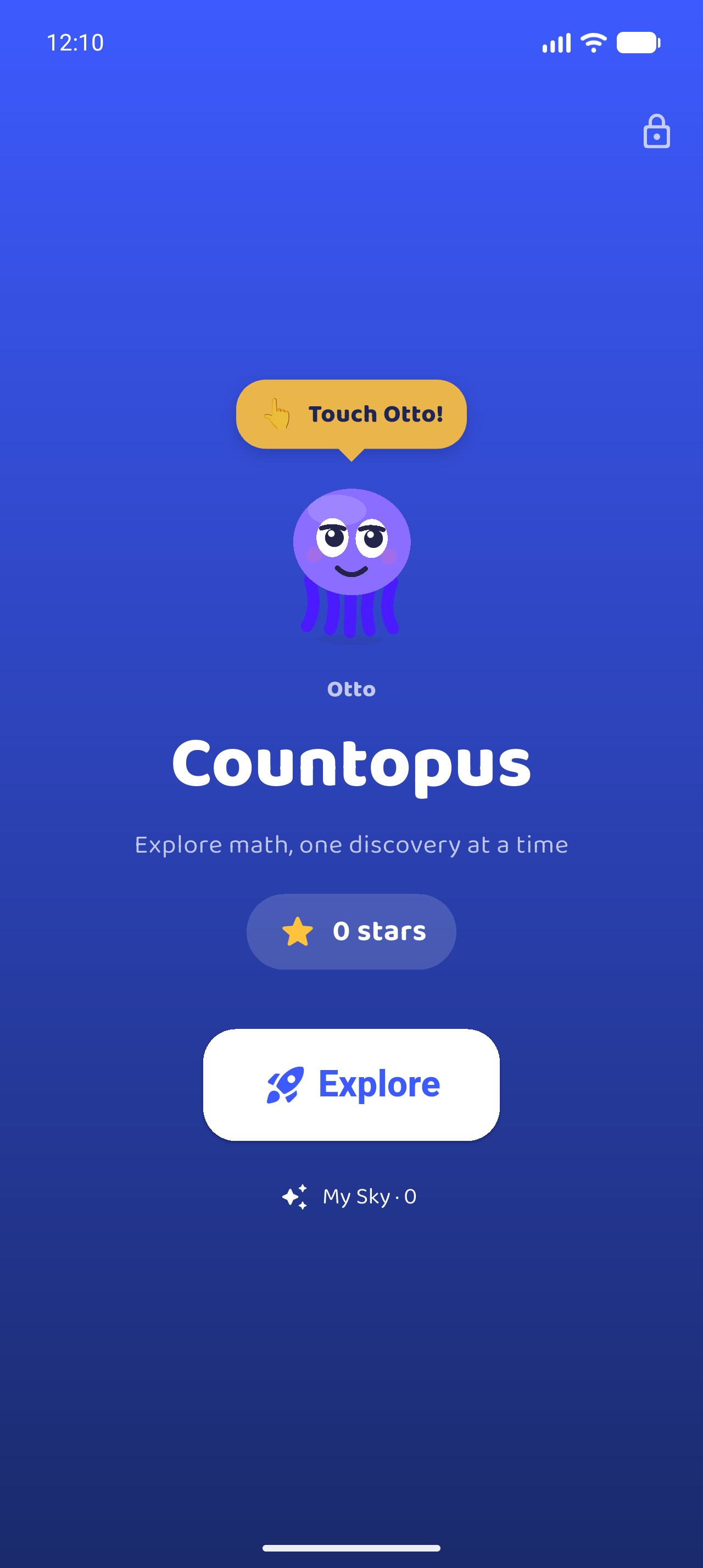
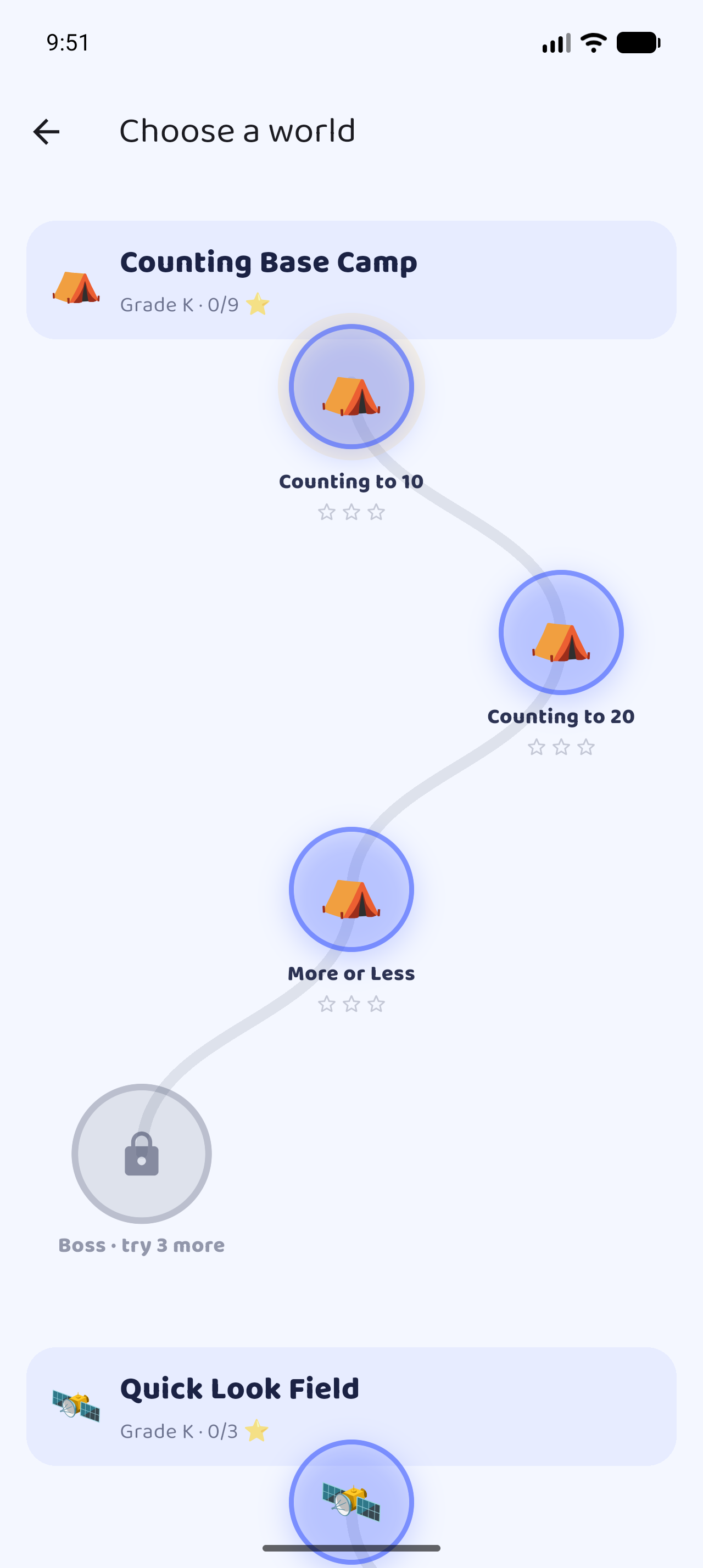
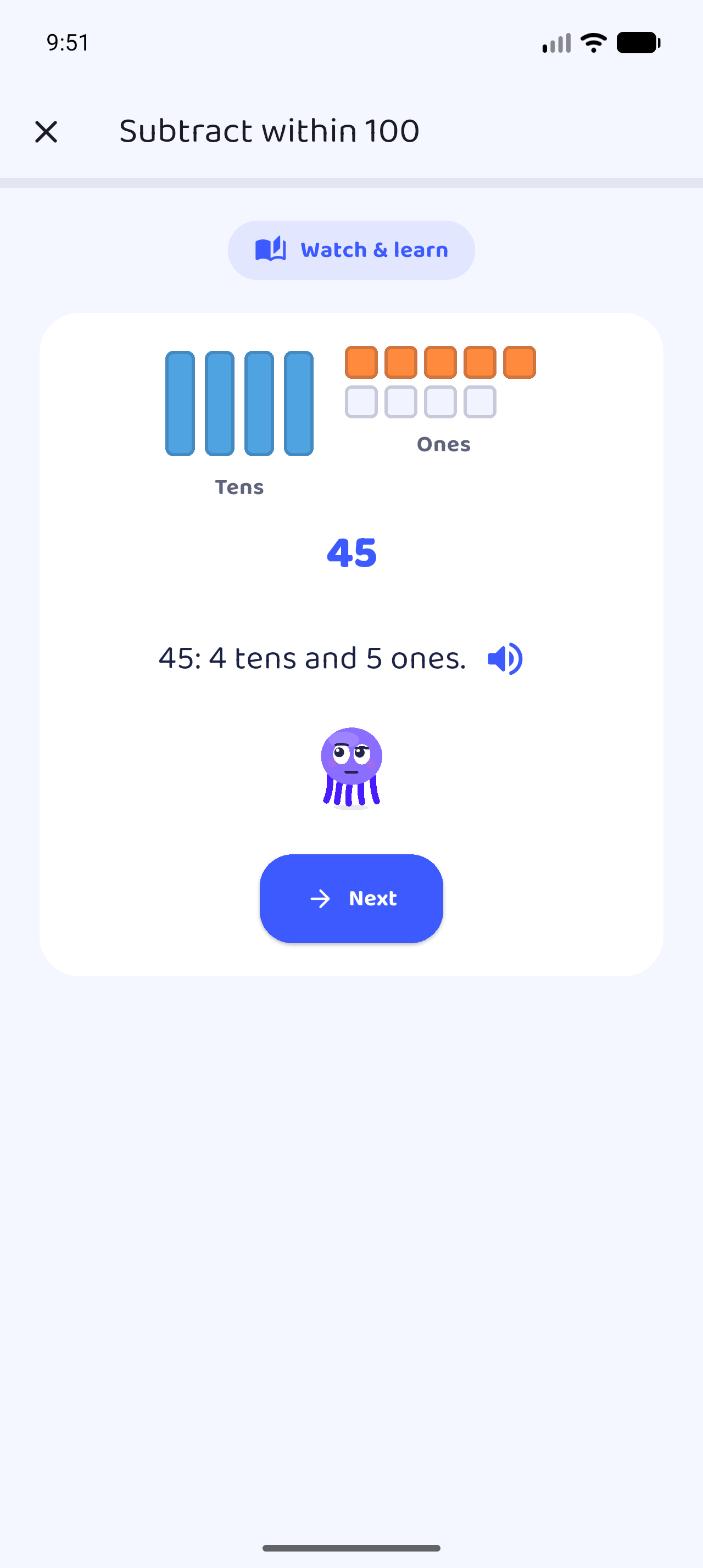
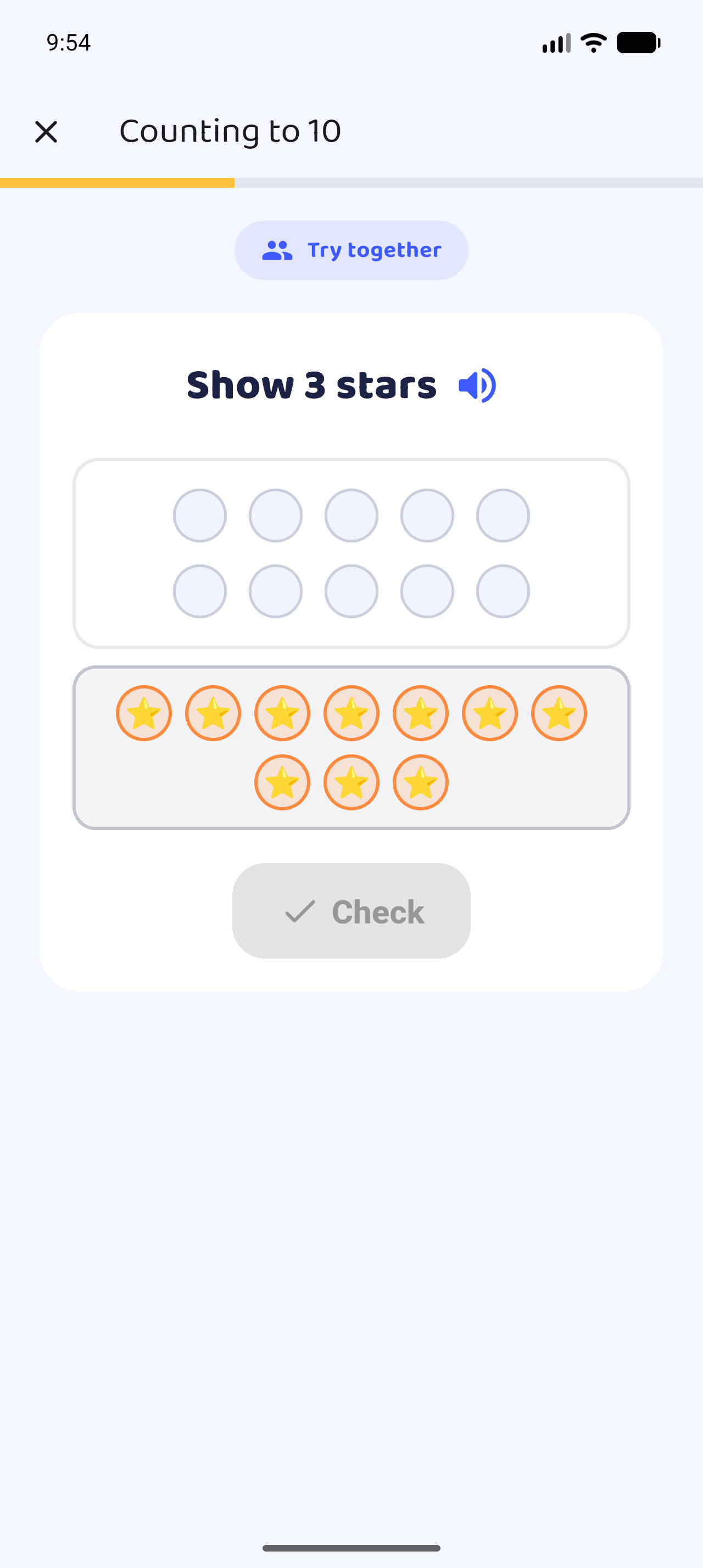
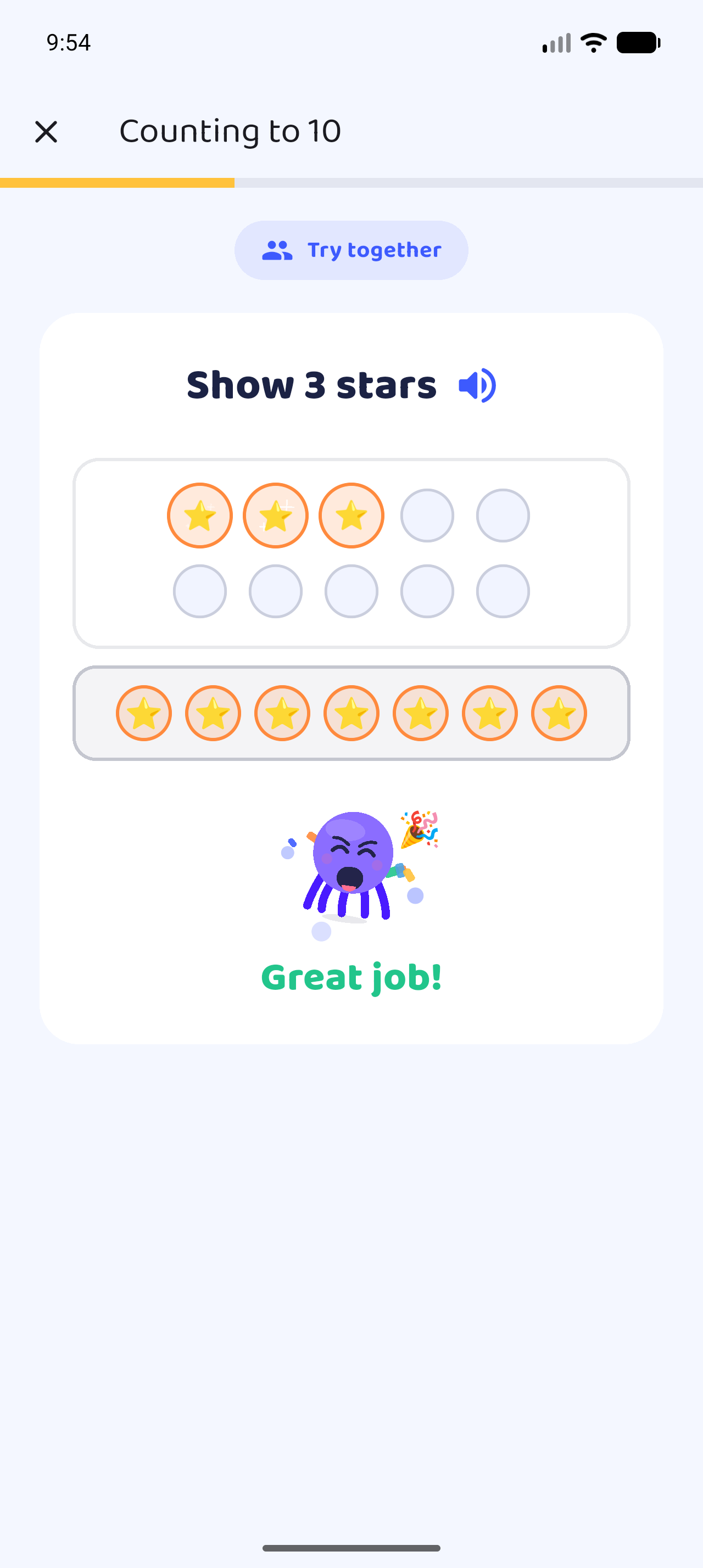
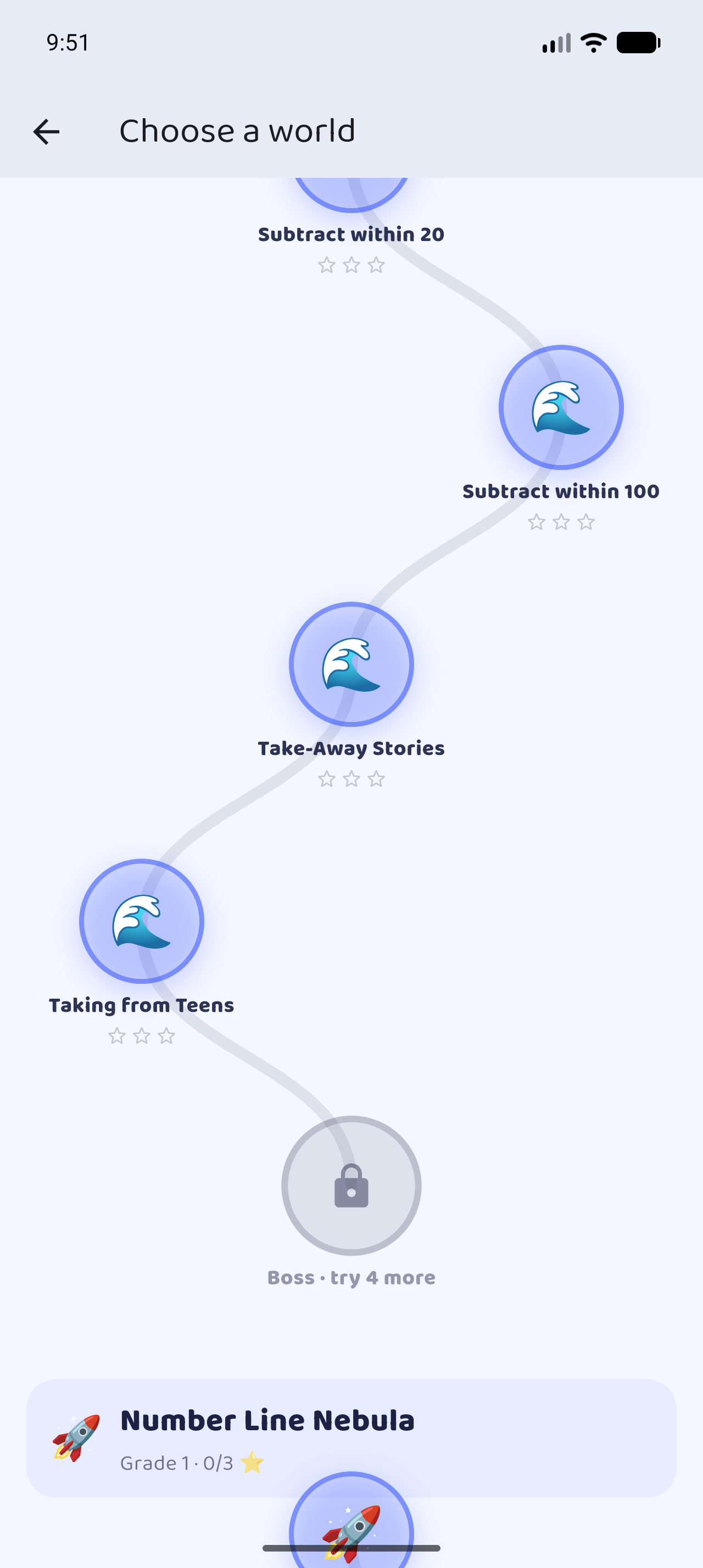
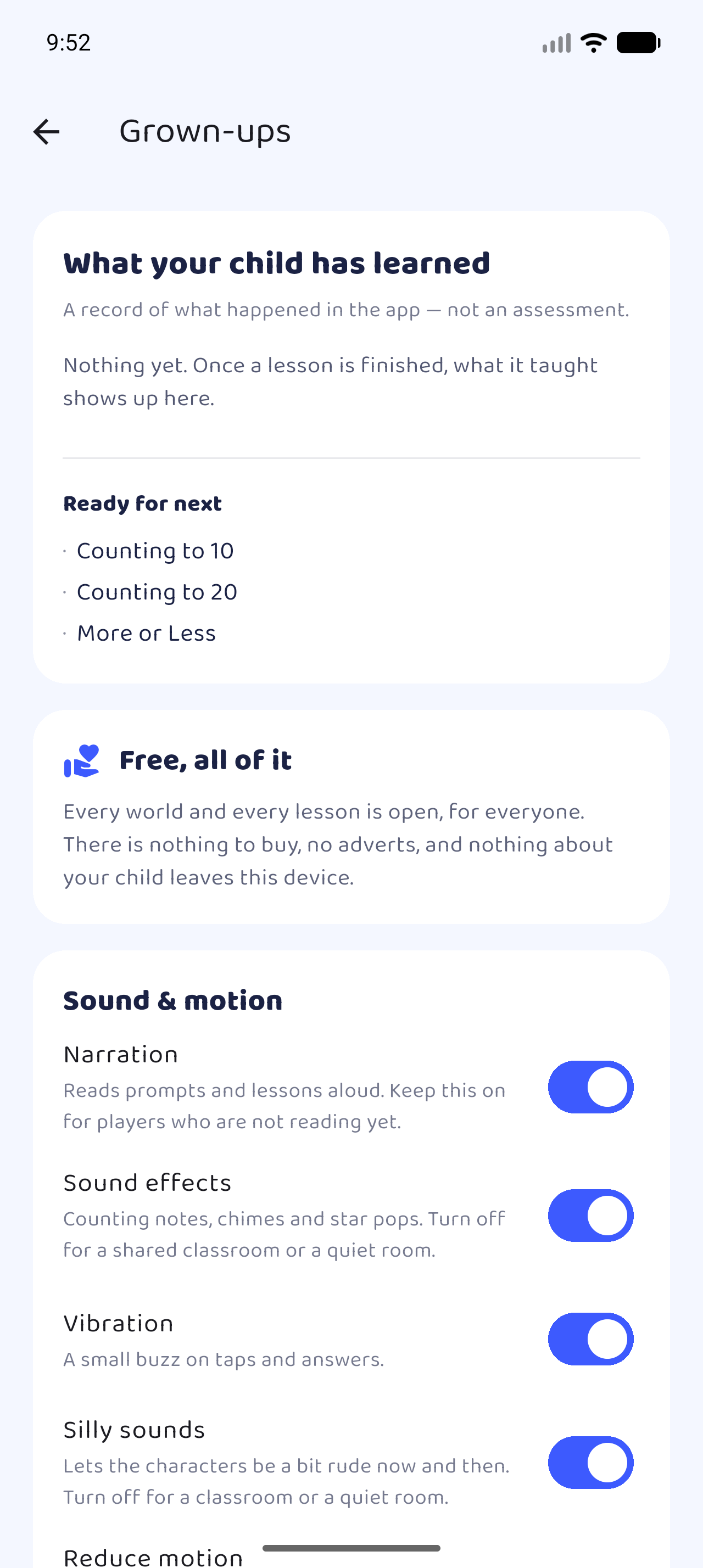
How children learn here: Concrete → Pictorial → Abstract
The sequence behind Singapore maths. An idea is handled before it is drawn, and drawn before it is written as symbols — so the symbols arrive meaning something.
Concrete
The child moves real objects — dragging counters into a ten-frame, hopping along a number line, building 45 out of tens and ones.
Pictorial
The same idea as a picture: bar models for story problems, arrays for multiplication, number bonds for parts and wholes.
Abstract
Only then the notation — 4 + 3 = 7 — attached to something the child has already done with their hands.
What is inside
29 worlds · 72 lessons · 15 strands of the K–5 curriculum — every one of them open from the first launch.
Kindergarten
- Counting Base Camp
- Quick Look Field
- Addition Launchpad
- Take-Away Bay
Grade 1
- Number Line Nebula
- Place Value Planet
- Number Bond Station
- Pattern Path
- Strategy Flight School
- Clock Tower
- Shape Station
- Measure Lab
Grade 2
- Subtraction Summit
- Story Problem Bay
- Big Number City
- Skip Count Orbit
- Coin Cove
- Space Solids
- Graph Galaxy
- Times Table Station
Grade 3
- Rounding Ridge
- Multiplication Galaxy
- Division Depot
- Area & Perimeter Park
- Division Facts Bay
Grade 4
- Fraction Pizza Planet
- Big Tables Outpost
- Big Division Depot
Grade 5
- Decimal Comet Cove
Built to teach, not to test
Real manipulatives
Ten-frames, counters, number lines, base-ten blocks, number bonds, bar models, arrays, fraction bars, clocks and coins — things to pick up and move.
A wrong answer teaches
No buzzer and no penalty. The app shows the correct picture, explains it, and invites another go.
Audio-first
Every prompt is read aloud, so a child who cannot read yet plays independently.
Calm by design
No timers. No streak to lose. No leaderboard. Nothing engineered to make a child anxious about stopping.
Stars & real mastery
Mastery needs a return visit, not one lucky run — so it means something when it appears.
A logbook for grown-ups
Plain sentences about what your child can now do, with dates. No percentages and no comparison to other children.
Made for parents to trust
Countopus was written by a father and teacher for his own children, and released free. There is no company behind it taking something in exchange.
- Free in full. Every world, every lesson, for everyone. No subscription, no in-app purchase, no “unlock the rest”.
- No advertising. No ad networks, no promotions, nothing sold to your child's attention.
- Nothing leaves the device. No account, no sign-up, no analytics SDK, no advertising identifiers. Progress is stored locally.
- A parent gate guards the grown-ups area and any link out of the app, as the App Store and Google Play require.
- Works offline. The whole curriculum ships inside the app.
Read the full kids privacy policy.
Questions parents ask
Is Countopus really free?
Yes — completely, and permanently. Every world and every lesson is open from the first launch. There is no subscription, no in-app purchase, no locked content and no trial that ends.
Are there ads?
No. There are no adverts of any kind and no ad networks in the app. Children never see a promotion, an interstitial or a video.
What data do you collect about my child?
None. There is no account and no sign-up. Learning progress is stored on the device and never uploaded. There are no advertising identifiers and no third-party tracking or analytics.
What ages is it for?
Roughly 5 to 11 — Kindergarten through Grade 5. Because every prompt is read aloud, children who cannot read yet can play without help.
Does it work offline?
Yes. The whole curriculum ships inside the app, so it works on a plane, in the car and anywhere with no signal.
How is it different from a maths quiz app?
It teaches rather than tests. Each skill is built up Concrete → Pictorial → Abstract with real manipulatives — ten-frames, number lines, base-ten blocks, number bonds, bar models — and a wrong answer is answered with a demonstration, not a buzzer.